We trained a transaction foundation model so every bank and fintech can grow revenue and stop fraud faster
By Oban MacTavish · 10/15/2026 · 5 min read
Today Spade is launching Predictions, built on a transaction foundation model we trained on payments behavior and the verified merchant behind every transaction. Banks and fintechs of every size can use it to grow revenue and stop fraud faster, with one model every team shares.
Predictions is the third product suite built on Spade’s Merchant Graph, alongside Enrichment and Data Operations. The Graph is our verified record of 99.9% of US and Canadian businesses. Predictions lets banks and fintechs of every size use our model and infrastructure three ways:
- Out of the box: run the model as it stands, with no data science team required.
- Fine-tuned: fine-tune it for a specific task, like finding the customers most likely to take out a loan.
- In their own models: use Spade’s software, infrastructure, and embeddings to build a model of their own or improve one they already run.
A customer’s spending shows what they need next, but most banks send everyone the same offers
A good branch banker knew who was about to buy a house, who had just had a child, and who had started a business. Banks lost most of that as they went digital. What they kept was the transaction record.
Spending is the contact a customer has with their bank most often, and it’s a leading indicator of what they’ll do next. A customer whose spending has turned into supplier payments has likely started a business. They would probably take a business account and a loan from their bank without being asked twice. A customer about to make the biggest purchase of their life shows it in their spending before they apply anywhere.
Most banks can’t read those signals, so they fall back on broad campaigns: the same loan offer mailed to millions of households, and the same coupon book in every customer’s app. I shop at Lululemon, and if a Lululemon offer sat at the top of the list in my banking app, I’d use it. Instead it sits somewhere in a list of a thousand offers, below ones for places like Sephora that I never shop at.
Holding the account no longer guarantees the spend, so transaction data is now a bank’s most valuable asset
A bank used to win a customer’s spending the day it opened their account. The customer got a checking account with a checkbook and a card, they paid for almost everything with them, and every purchase ran through the bank.
Today a customer can keep their paycheck going into one bank and spend through something else: a different card saved in their phone’s wallet, a pay-later plan at checkout, or a card built into a delivery or ride app. Switching takes one tap, and they never have to move the account. The bank keeps the account, and the purchases and the fees go somewhere else.
Every bank and fintech now competes for each purchase its customers make, something it used to receive automatically. The asset that matters most in that competition is its own transaction data: a first-party record of where and how every customer spends.
Banking’s AI race is on, and the largest institutions have already trained their own models
In the past eighteen months, Revolut, Nubank, Visa, Mastercard, Stripe and others have trained foundation models on their own transaction data, and more are following. A model like this learns how customers behave from where they spend. Each one required tens of millions of customers, a dedicated research team, and years of governed transaction history, and each serves only the institution that built it.
Forrester expects that “competitive advantage will shift to proprietary data, distribution, and outcome-based feedback loops.” The institutions that turn their own transaction data into an understanding of every customer first will be the ones that earn the spend.
The industry’s own research shows a known gap in that data: the merchant
Each transaction arrives the way card networks have always sent it, with a merchant name of up to 25 characters and a broad, outdated category code. Two real examples:
- SQ *PHILZ MOBILE arrives coded as a restaurant, because no category code exists for a coffee shop. It was Philz Coffee, paid through Square.
- DD *DOORDASH DOLLARGEN names the delivery app and arrives coded as a restaurant too. It was a Dollar General order placed through DoorDash.
A model trained on those two strings learns that the customer went to two restaurants. Whatever model a bank points at its transactions, including a large language model, can only work with what the transaction contains.
Visa, one of the institutions that has trained its own model, has published how much the merchant matters. In a Visa Research study of restaurants, the merchant’s name was worth about six times more to the model than any of the spending statistics. The researchers wrote that even payment companies with “the most detailed view of transactions do not have access to all required attributes.”
Federal Reserve researchers who built measures of consumer spending from card transactions dropped 13.3% of the dollar volume they studied because the merchants’ category codes were wrong. As they put it, “the accuracy of MCC assignments is not integral to the payment processing.”
Spade’s model starts with the merchant, and we built it for the whole industry
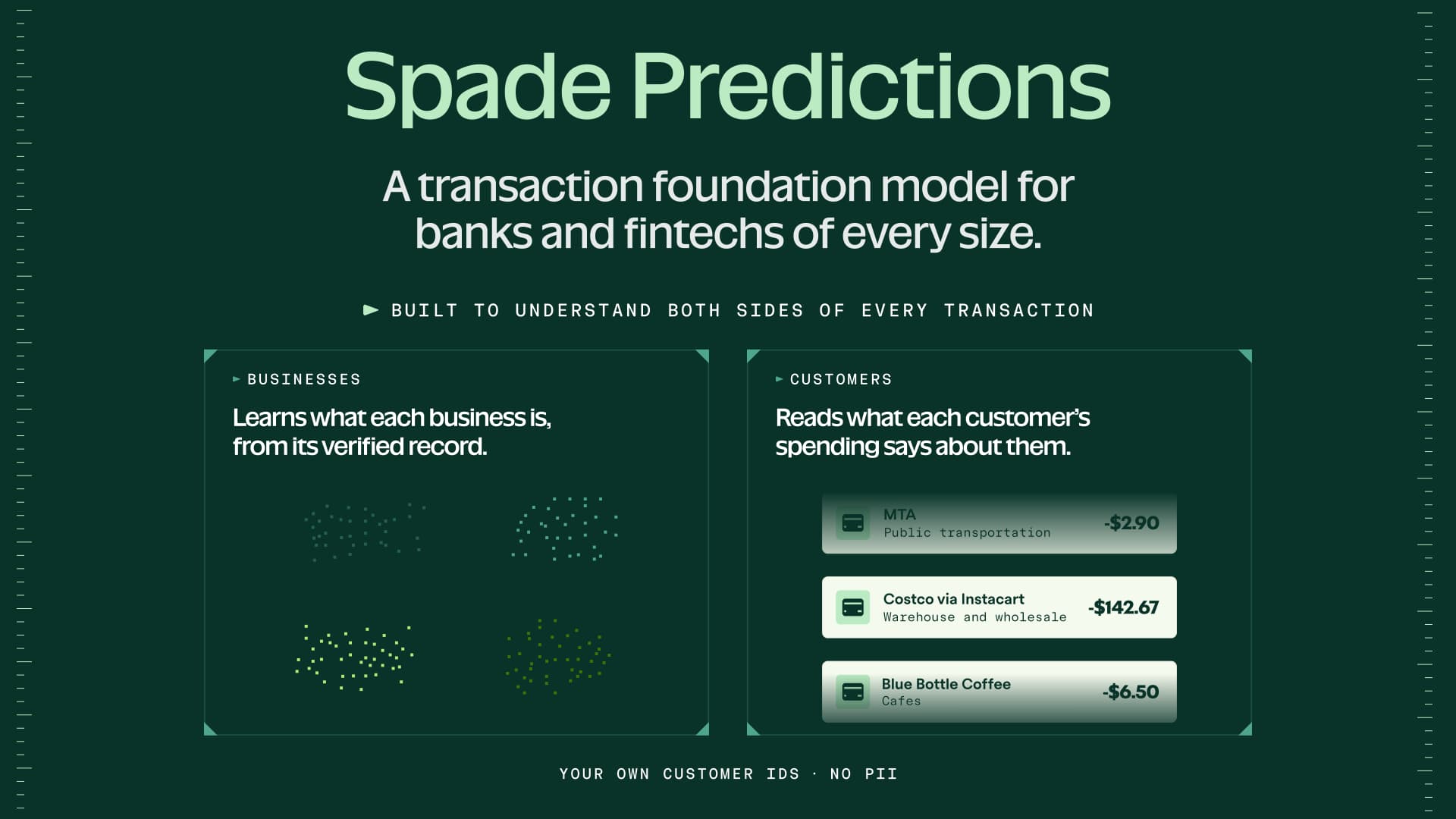
Predictions democratizes the competitive advantage the largest institutions have built for themselves, so every bank and fintech can use the same kind of technology, from the largest banks to regional institutions and fintechs. Spade’s model has two core components, starting with the merchant.
Merchant intelligence. The first learns what a business is, from Spade’s own verified record of it: the Merchant Graph. The Graph holds what each business actually is, what it sells, where it operates, which other businesses it resembles, how customers engage with it, and how every location rolls up to the brand and owner behind it. We turn everything the Graph knows about each business into a merchant embedding, a numerical representation the model learns from, so it can tell which businesses are alike and how they relate.
Behavioral intelligence. The second learns what a person’s spending says about them, with no personally identifiable information.

A model fine-tuned for one institution runs on that institution’s own customer identifiers.
One model can serve every team across an institution
Banks have long run a separate model for each job: a propensity model in marketing, a recommendation engine in product, segments in analytics, and rules and models in fraud. Spade’s model gives an institution one understanding of its customers and the businesses they pay, and every one of those teams can use it.
It can solve problems across the institution, from which product or offer fits each customer, to where they are likely to shop next, all the way to which merchants behave the way fraudulent ones do. A bank with fifteen products can see which one matters to each customer, and when.
Spade’s model beat a traditional propensity model by 35% and flagged fraudulent merchants early
Fine-tuned for a US bank’s lending program, Spade’s foundation model outperformed a traditional propensity model built for the same task by 35%. With Spade’s merchant embeddings, the model found roughly 10% more of the customers who went on to borrow than the same model without them. The model found who to reach, and the bank made every credit decision.
Fine-tuned to detect fraud rings, the same foundation model replayed eight months of a card issuer’s transactions. Of all the fraudulent spend that cleared in that time, it would have flagged the merchants early enough for the issuer to block up to $3 million of it. In one case the warning came five months before the issuer’s first recorded block.
Predictions joins Enrichment and Data Operations on the same Merchant Graph

- Enrichment: matches each transaction to the Merchant Graph and puts the verified merchant on it, over 99% accurate in under 40ms at p99. It covers every rail: card, ACH, wire, RTP, ATM, checks, and internal transfers.
- Data Operations: lets an institution’s own teams register the merchants and categories that matter to them, with no merchant list to maintain, and ask questions of their own data in natural language.
- Predictions: turns how customers spend into decisions for every team, from which offer to show to which merchant to block.
All three are available through an API, an MCP server, and the Spade Console.
The bigger opportunity for AI in banking is growing revenue
Most of the AI conversation in banking right now is about agents and cost savings. Those are worth doing. The bigger opportunity is revenue: helping customers get the right product at the right time. Banking runs on trillions of dollars of revenue. Helping that machine work a little better creates far more value, for banks and for their customers, than taking another cost out of the contact center.
The institutions that win the next decade will build one understanding of their customers and put it to work in every team. Predictions gives every one of them a way to do it.
Five years in, we’re just getting started. If you want to see what Predictions can do with your own transaction data, reach out to our team at . Happy to talk through what we’re seeing.


